Partners
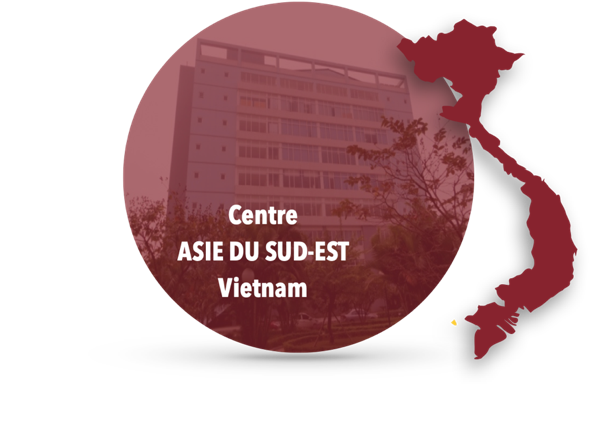
The Southeast Asia Center will rely on a new host institution, VinUniversity, to organize a network of researchers in the field of modeling and simulation applied to topics related to environment, water management, and traffic management. Its objective is to contribute to the unit’s research in terms of modeling and simulation methods, to promote the application of these methods in various fields of sustainable development, and to train future generations of experts in this field in Southeast Asia. The center will provide the following scientific contributions to the unit’s future themes.
Our themes
The Southeast Asia UMMISCO Center is distinguished by the presence of an International Joint Laboratory (LMI) called ACROSS, which originated from it. The objective of ACROSS is to design modeling and simulation tools dedicated to the sustainable and participatory management of irrigation systems in Vietnam, such as the RÁC project described in §3.4.3. Since 2021, ACROSS has promoted the development of methodologies and software tools to explore how best to involve local stakeholders in this management, in two emblematic systems (Bac Hung Hai in the Red River Delta and Duc Hoa in the Mekong Delta), representing contrasting agricultural regions, socio-environmental conditions, and water management issues. The Southeast Asia Center will continue to use LMI ACROSS as a structuring shared space, enabling better collaboration among its members within major projects such as STAR FARM and SIMPLE. Another structuring initiative is participation in the Erasmus+ SUCCESS project, which brings together 9 Vietnamese partners (from North to South, including four already involved in the center) and 3 European partners (including IRD), with the objective of creating a network of “third places” acting as interfaces between researchers and civil society, mainly on urban issues. In this project, modeling will play a central role in methodological exchanges between these two worlds, with the ambition of supporting mediation and citizen participation. Finally, the flagship project of the center on participatory approaches is SIMPLE, co-funded by the European Union, which explores the potential of virtual reality environments to raise awareness among young people aged 12–18 in four countries (Vietnam, Thailand, Laos, Cambodia) about complex environmental issues. The objective is to design a set of educational and interactive virtual environments, each dedicated to a specific issue and based on rigorous scientific models capable of producing realistic evolution scenarios. SIMPLE will make it possible to better understand the contribution of virtual reality interfaces in terms of immersion and enhanced stakeholder interaction with simulations, paving the way for broader use of these technologies in other projects. Among these projects is “Digital Twin Platform to Empower Communities with Eco-Friendly Environment and Health,” funded by VinUniversity’s Environmental Intelligence Center (2024–2026), addressing mobility, air quality, and urban health. This project will test the modeling methodologies of Theme 1 and the participatory technologies of Theme 4, using Hanoi as a case study, before extending the concept of a “participatory digital twin” to other cities in Vietnam and Southeast Asia.

A unique feature of the UMMISCO Southeast Asia Center, compared to other centers, is the presence of an International Mixed Laboratory (LMI) called ACROSS21 , which is an offshoot of the Center. The aim of ACROSS is to design modeling and simulation tools dedicated to the sustainable and participatory management of irrigation systems in Vietnam, such as the RÁC project described in §3.4.3. Since 2021, ACROSS has been promoting the construction of methodologies and IT tools that explore how best to contribute to the participation of local stakeholders in this management, in two emblematic systems (Bac Hung Hai in the Red River delta and Duc Hoa in the Mekong delta, which represent two extremes in terms of agricultural regions, socio-environmental conditions and problems linked to water management and sharing). The UMMISCO Center in Southeast Asia will continue to use the LMI ACROSS as a structuring common space, enabling center members to better share and collaborate on major projects such as STAR FARM and SIMPLE. Another structuring initiative is the center's participation in the Erasmus+ SUCCESS project, bringing together 9 Vietnamese partners (from North to South, including four already involved in the center) and 3 European partners (including IRD) with the aim of building a set of “third places” serving as an interface between researchers and civil society on mainly urban themes. In this project, modeling will be at the heart of methodological exchanges between these two worlds, with the ambition of best supporting mediation and citizen participation efforts. Finally, the center's flagship project on these “participative” aspects will be SIMPLE22, a project co-funded by the European Union and already presented in §3.4.3, which explores the potential of virtual reality universes to raise awareness of complex environmental issues among 12-18 year-olds in 4 countries (Vietnam, Thailand, Laos and Cambodia). The center's objective in the project will be to design a set of educational and entertaining virtual universes, each dedicated to a particular issue, representing a given case study (climate change in the Mekong Delta, the role of national parks in protecting biodiversity in Thailand, etc.), and built on rigorous scientific models capable of providing realistic evolution scenarios. In particular, SIMPLE will enable us to understand what new interfaces based on virtual reality bring in terms of immersion and improved ability of stakeholders to interact with simulations, paving the way for widespread use of these techniques in other projects. Among these other existing or planned projects is one entitled «Digital Twin Platform to Empower Communities with Eco-Friendly Environment and Health», covering aspects of mobility, air quality and health in the city. The project is funded by VinUniversity's Center for Environmental Intelligence from 2024 to 2026. The project will test the modeling methodologies of Theme 1 and the participatory technologies of Theme 4 with a case study in Hanoi, before extending the “Participatory Digital Twin” concept to other cities in Vietnam and Southeast Asia.
Our projects
DigEpi
DiDEM
DOM
RDT Smart Reader
U2worm
SIMPLE
NOCIME
ANR ESCAPE
COMOKIT
Our members